
- Update


Woodwell Climate Research Center (Woodwell) appreciates the opportunity to comment on the U.S. Environmental Protection Agency’s (EPA) and the U.S. Army Corps of Engineers’ (Army Corps) proposed rule to further update the definition of “Waters of the United States” (WOTUS). As a scientific research organization dedicated to understanding risk and promoting resilience, Woodwell consistently advocates for robust, science-informed, and publicly accessible data for long-lasting sustainability and the benefit of local communities.
The Sackett v. EPA decision in 2023 substantially limited federal protections for many wetlands and streams under the Clean Water Act (CWA). However, this proposed rule attempts to define terms critical to the definition of “waters of the United States” (WOTUS) as outlined in the CWA in ways that detrimentally narrow the definition of WOTUS even far beyond what is legally required by Sackett.
The Sackett decision maintains that the legal definition of WOTUS includes wetlands with a “continuous surface connection” to waters that otherwise qualify as WOTUS (streams, oceans, rivers, and lakes). This proposal attempts to define this “continuous surface connection” in terms of surface water, which unjustly extrapolates legal language and defies scientific expertise. In turn, this proposal would reduce vital protections provided by these waters that aid local communities and economies by improving resilience and reducing flooding, improving water quality, protecting fish and wildlife, and sequestering carbon.
Woodwell strongly opposes narrowing the definition of WOTUS beyond what is legally required by Sackett. This proposed rule rejects the science, the critical role of wetlands related to carbon sequestration, and the impact of wetlands on resilience. Failing to protect these waters will result in long-term economic and environmental costs that far outweigh any short-term “regulatory certainty.”
The three definitions outlined in this proposal, “relatively permanent,” “perennial,” and “continuous surface connection,” would each significantly limit the definition of WOTUS, exposing numerous ecosystems to undue harm and sacrificing vital ecosystem services.
This proposed rule aims to define the term “relatively permanent” as a “perennial body of water,” meaning a body of water that flows year-round. The only outlined exception is when a body of water does not flow for “no more than a single period of up to 30 consecutive days in any given year as a result of non-anomalous events resulting in a temporary interruption such as low tide or a regularly occurring dry spell.” This does not provide nearly enough flexibility for the unpredictability of water flows under increasing conditions of climate change.
This new definition of “relatively permanent” will exclude many rivers that provide important temporary connections to other bodies of water. Ephemeral rivers, short-lived streams formed only during precipitation events that carry water and pollution downstream, are integral to the health of the ecosystem1 and yet will be excluded under this definition. Further, this rule may even exclude the many rivers across the West that no longer flow year-round due to increasingly dire drought conditions and overextraction, yet are vitally important to the economies and livelihoods of Western states. Woodwell research has found that the socioeconomic and ecological exposure to extreme drought unequivocally increases with increased temperatures, meaning that as climate change continues to increase local temperatures, the drought effects observed in the West will only increase. Under this proposed rule and the requirement of a year-round flow, such conditions will further degrade and disqualify these temporary rivers from the protections afforded by WOTUS.
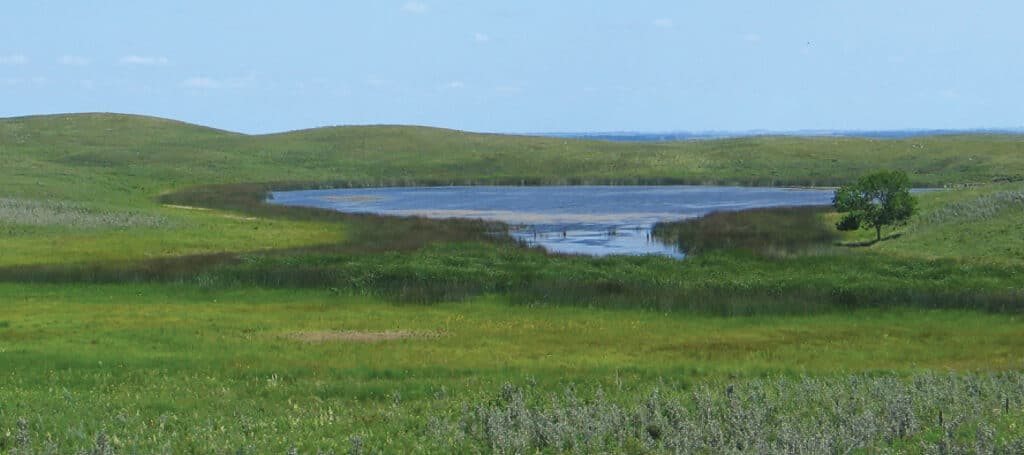
The proposed rule also seeks to codify a requirement that a “continuous surface connection” of surface water be maintained year-round, barring exceptional circumstances for up to 30 consecutive days. This detrimentally narrows the definition of WOTUS. However, hydrological connectivity is not just surface level. High-functioning wetlands that are connected to other surface waters only seasonally, briefly, or not at all, such as river floodplains, ponds, and prairie pothole wetlands, are often highly connected to sources of groundwater through subsurface flow.
Research in watersheds across the globe demonstrates that “isolated” wetlands are often anything but. As demonstrated by EPA scientists in 2023, wetlands can be limitedly connected at the surface while maintaining connection through subsurface flow, as well as the same ecosystem functions with regard to acidification, eutrophication, and sedimentation. The “continuous surface connection” as defined under this proposed rule does not consider subsurface connections and thus excludes these continentally important wetland types. Scientists have stated that if enacted, this definition would exclude more than half of the wetlands in the United States from WOTUS protections.
In Woodwell’s studies of river chemistry and watershed discharge, we have consistently found that wetlands have a strong influence on the health of entire watersheds, regardless of water surface connection. For example, Woodwell’s TIDE Project spent over two decades studying the Plum Island Estuary. The research shows that nutrient runoff from agriculture and development—even if it originates near seemingly “isolated” wetlands—eventually impacts the health of the entire estuary. By removing federal protections from wetlands that do not “touch” navigable water, the agencies are inviting a surge in nutrient pollution that will lead to eutrophication, algal blooms, and the eventual collapse of downstream aquatic ecosystems.
The proposed rule fails to account for the immense value of wetlands as carbon sinks. Terrestrial and tidal wetlands sequester and store more carbon per unit area than almost any other ecosystem on Earth, including forests.
Woodwell’s research identifies wetlands as high-carbon ecosystems that provide immediate climate benefits. “Terrestrial wetlands (i.e., non-tidal freshwater wetlands) cover about 71 million hectares in the U.S. About half of this area is forested wetland and 23% is peatland, which contains very high carbon stocks (Kolka et al. 2018). Terrestrial wetlands are significant carbon sinks, sequestering about 55 million metric tons of carbon per year both above- and below-ground.” Protecting these areas is a top priority for global carbon management because the carbon stored in wetland soils and biomass can be lost rapidly through drainage or surface hardening—actions that become much more likely without federal CWA oversight.
The 2025 proposal, upon which this proposed rule expands, argues that narrowing the definition of WOTUS will provide “regulatory certainty.” However, in reality, these revisions create profound environmental uncertainty by increasing the risk of catastrophic flooding and storm surges.
Wetlands absorb excess rainfall and buffer communities from the intensified flooding events caused by climate change. Woodwell scientists have documented how the loss of wetland capacity exacerbates flood risks for homes and businesses. The economic impacts are staggering: wetland losses over the past 40 years have increased flood insurance claims by an estimated total of $10.1 billion dollars. The proposed “relatively permanent” criteria under this jurisdiction is particularly dangerous, as it ignores the fact that ephemeral and seasonal wetlands provide vital flood-attenuation services during extreme weather events despite not existing year-round, let alone maintaining a “continuous surface connection.”
Additionally, coastal marshes are the first line of defense against rising sea levels. Woodwell’s research has shown that excess nitrogen (often filtered by upstream wetlands) causes marsh edges to collapse. By deregulating upstream “non-permanent” waters, the agencies will increase the nutrient load reaching the coast, weakening the very marshes that protect coastal infrastructure from storm surges.
Further, Woodwell is concerned by the proposal’s impact on the scope of “permafrost wetlands” through these “relatively permanent” and “continuous surface connection” requirements. The Arctic is warming three to four times faster than the rest of the planet. These increasing temperatures may threaten the permanence of these wetlands, thus excluding them from the vital protections afforded by WOTUS. Permafrost wetlands are critical for stabilizing the soil and sequestering vast stores of carbon, meaning they are critically important for maintaining the safety and livelihoods of local communities, as well as lessening the global effects of climate change.
The proposed rule rejects scientific evidence and treats the landscape as a collection of disconnected parts rather than a single, integrated hydrological and biological system. Such oversight will lead to the degradation of wetlands and other bodies of water that provide critical ecosystem services to both local and global populations. Woodwell Climate Research Center thus urges the EPA and Army Corps to:
The narrowing of this definition beyond what is legally required by Sackett v. EPA will detrimentally endanger the communities who rely on these increasingly threatened waters to endure the impacts of climate change. Failing to protect these waters will result in long-term economic and environmental costs that far outweigh any short-term “regulatory certainty.”